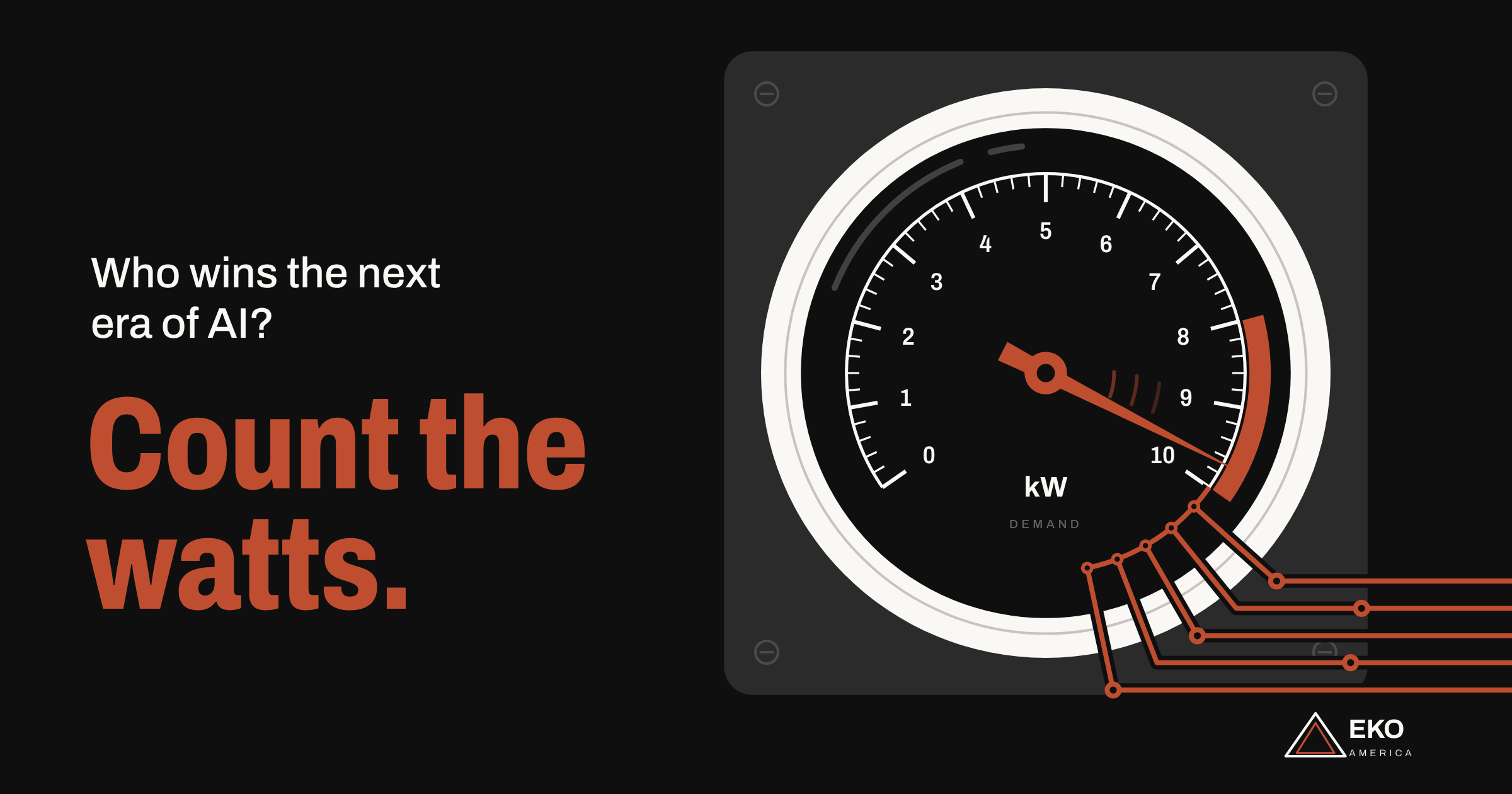
Everyone is asking who will win the AI race. Almost no one is asking what the race is actually measured in.
I think it is watts.
The companies and countries that get the most intelligence out of every unit of electricity will own the next decade. The technology that does it may not exist yet, or it may be sitting in a notebook somewhere, waiting to be funded.
Investment capital is moving fast
AI startups took $102 billion, or 64%, of the $159 billion in global venture funding in Q3 2026, and a record 27 companies raised rounds of $1 billion or more. Venture funding for the first three quarters of the year has reached $679 billion, the highest on record for that period.
The four largest US cloud companies have told investors they will spend roughly $700 billion on capital expenditure in 2026, most of it directed at AI computing infrastructure. So much money is being bet on scaling technology that is hungry for more energy than our grid can provide.
Capital is flowing at record scale toward more compute. The question is how much intelligence each dollar, and each watt, will buy.
The bottleneck nobody is adequately planning for
AI is increasingly limited by the grid, not by demand or capability.
- The US Energy Secretary says utilities can't build data centers fast enough because they can't get enough power.
- BloombergNEF projects data centers will use about 20% of US electricity by 2035, up from 5.9% today.
- Only China seems to be scaling energy production fast enough for future compute demand. One industry summary reports China added 543 GW of power capacity in 2024, more than the US has added in its entire history, and projects about 400 GW of spare capacity there by 2030. Morgan Stanley forecasts a 44 GW power shortfall for US data centers within three years. That is an edge the US cannot easily close.
The question that will decide who wins
Do we solve this by scaling power production, or by creating a new technology platform that delivers orders of magnitude more compute per watt on the grid we already have?
Who delivers the most compute per megawatt? Google reported a 33-fold drop in energy per Gemini query in 2025, yet total data center use is still growing about 15% a year. Cheaper compute gets used more, so efficiency gains alone do not close the gap. The winner will be whoever delivers a step change in output per watt, not another incremental gain.
Will the answer be a better version of today's chips, or something entirely new, like neuromorphic chips or hybrid systems? Quantum computing working in tandem with standard computing will likely play a role, each handling the tasks it suits best. For some problems, quantum computers may be far more energy efficient, and published research has shown a theoretical energy advantage for at least one specific problem. But they are not the answer for everyday work like web searches. Brain-inspired designs point to the same upside. The human brain runs on roughly 20 watts, and a 2020 research estimate puts the computing needed to match its task performance at about 1,000 trillion operations per second. A frontier AI data center draws megawatts. They are different machines, but the gap hints at how much room remains.
Who is building for a future that has not been invented yet? Data centers are long-lived assets. If a breakthrough arrives, rigid infrastructure tied to today's chips could be stranded. The risk is locking in billions of dollars of design assumptions that a better platform could make obsolete.
The open question
Light-based chips, brain-inspired circuits, analog compute, hybrid systems, or something no one has named yet: one of them will close the gap, and the company behind it may not have raised its first dollar.
If you are building it, I want to hear from you. I run EKO America, where we help founders turn big ideas into investor-ready companies, and this is a question I will keep exploring here.
Sources
- Energy Intelligence: US grid constraints dent data center demand outlook
- BloombergNEF via Bloomberg Government
- China vs U.S.: Race to Generate Power for AI Data Centers (IEEE ComSoc Technology Blog)
- Crunchbase Q3 2026 summary (FourWeekMBA)
- A $700 Billion AI Infrastructure Bet (Wright Research)
- Sopra Steria: AI and the Jevons paradox
- Energy-Consumption Advantage of Quantum Computation (arXiv)
- Singularity Hub: brain-like computing and the 20-watt brain
- How Much Computational Power Does It Take to Match the Human Brain? (Joe Carlsmith)